Day #2, Friday, May 28, 2010
Time of Report: 2100 Z
Position: 32.11 N, 79.29W
Heading: 140, bearing 128
Speed: Apparent Speed is 3.4 knots; Actual Speed is 2.5 knots
In every blog posting, we’ll be using the format above. For those who are not as “tuned in” to all of the nautical lingo, here’s a quick lesson on a few things:
1. When we talk about time in the report, ‘we’re using Zulu time, which is Greenwich Mean Time. During daylight savings, East Coast time is minus four hours, so in this example, 2100 Z is the same as 1700 EDT
2. We will show two types of speeds, Apparent (through the water) and Actual (over the water). Here’s the difference, the Apparent speed is the speed of the boat relative to the water with which it is in contact and Actual speed is the speed of the boat with regard to a fixed position.
3. A Rhumb line is a line crossing all meridians of longitude at the same angle, i.e. a path derived from a defined initial bearing. That is, upon taking an initial bearing, one proceeds along the same bearing, without changing the direction as measured relative to true north.
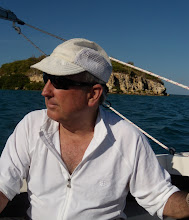
Rewinding to Thursday, on their way to sea, Woody & JD spent a little time on a sandbar. The incoming tide allowed for them to gracefully slide out around 2030 Z, but due to unfavorable tides and wind, they had to motor out of the Sound. Thursday night, the winds were light and they motored part of the night to keep moving. JD reported an incredible sunrise on Friday morning, as he had the 0400 to 0800 watch. He said it was one of those that you in religious/spiritual materials and I got the feeling it was a wonderful way for him to welcome in his first day at sea. Friday was spent with adverse light wind, right on the nose and an adverse current and they spent the day tacking back and forth with 120 degree arcs (typical tack arc should be 90 degrees, to give you an idea). It sounded pretty frustrating but they were keeping their spirits up. Dinner was Chicken Alfredo, and Woody described their rations to me. The have three large black trash bags, one is for mutal rations, such as the Chicken Alfredo, and the other two are for individual rations. They expected to enter the Gulf Stream on Saturday morning which will fetch them North, and by the Spot-Finder, it looks as if they are right on track.
Bill Tumlin (BT) is expecting to hear from Woody tonight at 2200 Z to give him a weather report, and Alice (his wife) talked with him and got a report once they hit the Gulf Stream and said it was a beautiful indigo blue, and that they were speeding along.
On another note, here’s the link to the YouTube that Parker, Woody’s son put together for him for the Bon Voyage that we weren’t able to view that evening: http://www.youtube.com/watch?v=axBufuE4qHo&feature=email
And for one of the most famous quotes of sailing times…. There is nothing - absolutely nothing - half so much worth doing as simply messing about in boats. - Water Rat, Kenneth Grahame, The Wind in the Willows
More Soon! Tracy
Saturday, May 29, 2010


Thursday, May 27, 2010
Woody & JD Depart for Bermuda
 At 9:43am this morning, Woody Norwood & JD Shiver set sail from Beaufort, SC to Bermuda. Some friends from Beaufort, Jim Travis and Reggie followed them out for a bit, and thanks to Vosbury's for taking the pictures! For those of you who are wondering who is behind the keyboard, my name is Tracy Tumlin Allardice and I am one of Woody's very proud nieces. My husband, Darryl and I are the Communications Crew and will be updating the blog while Woody is at sea.
We expect to hear from him daily via his satellite phone and he will be checking in with my father, Bill Tumlin (BT) for weather updates.

If you would like to receive updates from the blog via email, please get signed up, but clicking on the orange icon, just to the left to get signed up.
Here's a note Woody sent early this morning:
" We are definitely departing today. The sun is shining and we should have generally northerly wind all day, getting stronger as we get offshore. I expect 15 to 20 knots (kts) this afternoon and tonight. There are no tropical storms in sight. However, we will be going through the Gulf Stream (GS) all day tomorrow, and with a northeast wind at around 15 kts, opposing the direction of flow of the GS, the wave heights will be significant (8 +feet) and steep. By tomorrow night we expect calmer seas. After sailing through the GS we will have to dodge the northern curl of an eddy. This eddy is termed a "warm eddy", spinning off the GS and rotating counterwise. We will sail south of the rhumb line Sunday-Monday to avoid the adverse current and maybe even pick up a boost on the south edge of the current.
Longer term the wind looks light and will be adverse for a couple of days. If it is light and adverse we'll use the engine some. We have enough fuel for roughly 200 miles.
The boat is loaded. We are running last-minute errands this morning, including a run to the dump with trash. We bought more food than we need (or could possibly fit on the boat. Tha addage is, "Don't send a hungry man to the grocery store". We will leave this legacy to our neighbors at Carriage Court in Beaufort. Enough Ramon Noodles to put a young person through a semester of college.
~ Woody"
 I did hear from Woody & JD around 2:00pm today. On their way out to sea, they took a short cut through Bay Point Reach, but the tide was not their friend and ran out on them which caused them to run aground - just in the sand. So they jumped in the water, cleaned the bottom of the boat and did a little swimming and R&R, waiting for the tide to come in. They were expecting to be back at sail around 5:00pm, spirits were high.
Bill Tumlin (BT) is serving as Weather man and was ready with a report at 5:00pm for Woody. BT had been tracking the progress (to do so, click on the Spot Finder to the left) and noticed the tracks stopped around 12:30pm and figured he must be off the coast. Little did he know that he was literally on the coast. We expect to get tracks around noon each day from the spot tracker.
Last Saturday night about 40 people gathered for a Bon Voyage party for Woody & JD. We had such a great time and Woody's kids, Liz and Parker and their families joined us via conference and sent YouTube videos. I'll post the links of their videos and pictures of that evening in the days to come.
In closing, please find one of my favorite quotes:
There are good ships, and there are wood ships,
The ships that sail the sea.
But the best ships, are friendships,
And may they always be.
More soon! Tracy
Sunday, May 23, 2010
Bon Voyage Party; departure postponed
On Saturday evening friends and relatives from Beaufort, Atlanta, Savannah and Charleston attendeda Bon Voyage party in honor of JD and me held at the Beaufort Yacht and Sailing Club. This had been organized primarily by my sister and her family (Atlanta) and my good friend Frank Pontious in Beaufort. After everyone toured "Jubilee" the 30 to 40 of us enjoyed libations and a dinner of hors d'oeuvres, toasts, and friendship for a wonderful send-off.
Our departure, which had looked good for Sunday evening just 3 days ago has been postponed due to a forecast of gale force adverse winds and predictions of 15-foot waves related to a low pressure systems emerging out of the Bahamas that might become the season's first named tropical storm. This system would have crossed our path Monday-Tuesday just as we would be crossing the Gulf Stream. Packing winds in excess of 30 kts from the northeast, this system will likely be creating conditions that even large ships try to avoid.
It now looks like Thursday morning we will head down the Beaufort River and out to sea bound for Bermuda. The good news is that this gives us a few relaxed days to do some additional preparations and to be fully rested before leaving. The week leading up to departure on an offshore voyage is a lot like the week before opening night in a theatrical production. Inevitably there are a thousand things to be done. I will be away from home nearly 3 months. That alone is a big deal in terms of preparations. Then the boat. My rigger, Greg Pittrizzi, installed a new throttle control Friday and new fresh and sea water pumps yesterday(Saturday) morning. Other, less major, items still need attention.
Our departure, which had looked good for Sunday evening just 3 days ago has been postponed due to a forecast of gale force adverse winds and predictions of 15-foot waves related to a low pressure systems emerging out of the Bahamas that might become the season's first named tropical storm. This system would have crossed our path Monday-Tuesday just as we would be crossing the Gulf Stream. Packing winds in excess of 30 kts from the northeast, this system will likely be creating conditions that even large ships try to avoid.
It now looks like Thursday morning we will head down the Beaufort River and out to sea bound for Bermuda. The good news is that this gives us a few relaxed days to do some additional preparations and to be fully rested before leaving. The week leading up to departure on an offshore voyage is a lot like the week before opening night in a theatrical production. Inevitably there are a thousand things to be done. I will be away from home nearly 3 months. That alone is a big deal in terms of preparations. Then the boat. My rigger, Greg Pittrizzi, installed a new throttle control Friday and new fresh and sea water pumps yesterday(Saturday) morning. Other, less major, items still need attention.
Saturday, May 22, 2010
Pictures from Sea Trial (aka Shake Down Cruise)
JD took these on our shakedown cruise.  The first is at sundown the first day, already well offshore. The pole on the starboard quarter goes up to the wind generator. The pole on the port quarter goes up to the radar. That package you see on the port stern contains our "LifeSling" man-over-board rescue device. You'll notice that I am wearing an inflatable life vest. It inflates with the pull of a string. It also serves as a harness. I have a six-foot and a three-foot tether that connects me to a "jackline" (nylon strap) that runs the length of the boat on both sides. Our rule is that we clip on anytime we are outside the cabin. The second picture is of our approach to Charleston the next day.
  The safety netting helps keep the downed foresails on board as well as our bodies. The third picture, obviously taken from within the cabin, shows that we did not fully properly repack the LifeSling after our M.O.B. drill, On the left is the door to the "head". A back-up hand-held GPS is in my lap. You'll notice a platform just outside the companionway (the case for my cell phone and a line is on it). This platform covers our life raft and ditch kit. It is important to have these items in a place that is easy to get to in an emergency. The life-raft is a four-person, a vacuum-packed raft that, with the pull of a line, will automatically unfold and inflate itself. It has a sheltering room. The ditch kit includes signal flares, a signaling mirror, a GPS, a VHF radio, a fishing kit, emergency rations, some fresh water, and a water-maker that converts sea water into fresh water. Just inside the companionway is our principal EPIRB signaling beacon device. In an emergency we can push a button on the EPIRB and it will automatically send an SOS signal to a satellite showing our precise location, identifying exactly who we are, and triggering a rescue mission by the Coast Guard or whatever rescue is close by. Signals will also get forwarded to all ships in the area. I hope we don't have to use any of the emergency stuff, but it is comforting to know that we are prepared.

 The first is at sundown the first day, already well offshore. The pole on the starboard quarter goes up to the wind generator. The pole on the port quarter goes up to the radar. That package you see on the port stern contains our "LifeSling" man-over-board rescue device. You'll notice that I am wearing an inflatable life vest. It inflates with the pull of a string. It also serves as a harness. I have a six-foot and a three-foot tether that connects me to a "jackline" (nylon strap) that runs the length of the boat on both sides. Our rule is that we clip on anytime we are outside the cabin. The second picture is of our approach to Charleston the next day.
  The safety netting helps keep the downed foresails on board as well as our bodies. The third picture, obviously taken from within the cabin, shows that we did not fully properly repack the LifeSling after our M.O.B. drill, On the left is the door to the "head". A back-up hand-held GPS is in my lap. You'll notice a platform just outside the companionway (the case for my cell phone and a line is on it). This platform covers our life raft and ditch kit. It is important to have these items in a place that is easy to get to in an emergency. The life-raft is a four-person, a vacuum-packed raft that, with the pull of a line, will automatically unfold and inflate itself. It has a sheltering room. The ditch kit includes signal flares, a signaling mirror, a GPS, a VHF radio, a fishing kit, emergency rations, some fresh water, and a water-maker that converts sea water into fresh water. Just inside the companionway is our principal EPIRB signaling beacon device. In an emergency we can push a button on the EPIRB and it will automatically send an SOS signal to a satellite showing our precise location, identifying exactly who we are, and triggering a rescue mission by the Coast Guard or whatever rescue is close by. Signals will also get forwarded to all ships in the area. I hope we don't have to use any of the emergency stuff, but it is comforting to know that we are prepared.
Wednesday, May 12, 2010
Report on Sea Trial
Our sea trial round trip from Beaufort to Charleston was 3 days, 2 nights at sea with 15 to 25 kt winds. Each direction took about 18 hours over-the-ground (by the GPS). We averaged 4.4 kts with a mix of favorable and unfavorable tidal currents, wind directions, and some use of the engine. True to the purpose of a sea trial, we found that some things did not work and we needed to change some things. This was JD's first night offshore in a sailboat. On the second night he described his sleep "like a stone". We returned happy, with a to-do list, and with enthusiasm for the fist leg of the big trip: to Bermuda, departing around May 24. Please see the full story at my website.
Woody
Woody
Tuesday, May 4, 2010
Sea Trial Begins on Friday - from Beaufort to Charleson & Back

Preparations are coming along toward a 3-day sea trial starting this Friday, May 7. The plan is JD, my sailing partner from Beaufort, SC to Bermuda and Bermuda to Nova Scotia will drive from Athens, GA to Beaufort on Thursday evening. We'll turn loose the dock lines around noon on Friday and sail up to Charleston, arriving Saturday in time for lunch and a walk around. Then we'll depart Charleston and spend Saturday night at sea, returning to Beaufort Sunday evening.
Right now, the weather looks fine although we could have a thunderstorm on Saturday. We'll deal with it just as we would at sea.
JD will be bringing all of his gear, though we might not take it all on the trial. The goal is to go through what his has and identify anything else that is needed. Synthetics are key to avoiding mildew and allow for quick drying.
The last items for the boat were installed yesterday. The main item was an extension of the keel to overlap the bottom of the rudder. This is intended to keep crab and lobster trap lines and fishing nets and other debris from getting tangled between the keel and the rudder.
Last night I made a plexiglass companionway cover that we'll use at sea in the rain. This will allow us to be able to read the instruments that are on the swinging panel in the companionway from the cockpit while keeping the rain out of the cabin.
The boat has been compounded and waxed and looks good. It is raining today, and the boat is suspended on the launching machine while the keel extension sets up. Tomorrow (Wednesday) we plan to step the mast and install the radar and wind generator and test the electrical system, then launch on the high tide in the afternoon. Thursday, my rigger (Greg Pittrizzi) and I will take her out to synchronize the systems, set the wind gauge compass, and ensure that the various systems are talking to each other in a coordinated way. We'll also test the charging systems.
Other things that are still on the list of "To Do's" today are I need to scrub out and sanitize the water tank and its pipes and then fill it. Also, on the inside, I need to check out the stove and install the holders for the propane portable heater. Additionally, I'll be installing a system of nylon straps to keep our gear and the sail inventory from sliding around while we are at sea. These are among today's tasks.
Tuesday, April 20, 2010
Sailing in December
JD Shiver and I needed to practice sailing together, offshore, to be sure that we would be compatible teammates on our passage in May and June to Bermuda and Nova Scotia. JD has had little offshore experience but is bright, has a natural talent for sailing, is blessed with good common sense, and can fix anything. I have sailed a lot, including some offshore, but I am a klutz at fixing things. Neither of us wanted to find out, half way to Bermuda, that we could not get along or that an offshore voyage was just something that we are actually not personally equipped to handle.
“Jubilee” was on her trailer at Marsh Harbor Boatyard for the winter. I have another sailboat however, that we could use for a short excursion offshore. “Myrdie II” is a Compac 16 sloop built in 1982. This is a very seaworthy craft for its size, weighing about 1,100 pounds and having a self-draining cockpit and a board covering the companionway to the small cabin to keep a breaking sea from swamping the interior.
We drove to Beaufort, SC, on a Friday afternoon, launched Myrdie II at Beaufort Yacht and Sailing Club (BYSC) and prepared her for sailing Saturday and Sunday. The weather predicted for Saturday was for temperatures in the 40s, rain, and north to northeasterly winds at 15 to 20 knots. For Sunday, the temperature would rise into the 50s and the winds would be a bit lighter, clocking to the east and southeast, but the seas would be large. Sunday’s ground swells, 5 to 7 feet offshore, and 8 to 10 feet closer in, would be generated in the Gulf Stream, some 60 miles offshore, on Saturday and Saturday night as the northeast wind would be blowing in the exact opposite direction from the flow of the Stream. This would be a perfect weekend to accomplish what we were setting out to do: Test ourselves in tough conditions.
You really never know what a person is like until you work with him (or her) under stress. Had this weekend been one of just a pleasant sail, we would not have come to know each other as we did in these stressful conditions.
Our objective was to sail from Beaufort north and east about 20 nautical miles (nm) on The Intracoastal Waterway (ICW) Saturday to Dataw Marina. On Sunday we would sail east from Dataw into the Atlantic, then turn south to Port Royal Sound, west into the Sound, and north on the Beaufort River back to BYSC. Sunday’s voyage would be about 40 nm as the crow flies. Tacking into the wind most of the day would add another 16 nm.
Saturday’s trip to Dataw was cold and wet. We learned the value of well-insulated gloves and competent foul weather gear. The little Compac sailboat had no trouble handling the 15-20 kt winds, and, although chilled nearly to the bone, this was a fine test of equipment and positive attitude.
Sunday would turn out to be quite a challenge. We left the Dataw dock at 7 AM, in the pre-dawn gray with a misty rain and wind directly on the nose. We used Myrdie’s 2 HP Honda outboard to motor out into the Atlantic. S we left the Morgan River into the Atlantic, we hoisted the sails and turned southeast across the bay on a route that in normal conditions would be fine. However, these were not normal conditions. We soon found ourselves in a field of breakers. Waves start to break when the height of the wave matches the depth of the water. We were in water with an 8 to 10 foot depth, plenty for the 3-foot 3-inch draft of a Compac 16. The 5 to 7-foot waves grew in the shallow water to 8 to 10 feet, and they were breaking all around us. We put the board into the companionway. We tacked over to Starboard and cranked up the motor to get to deeper water. Then, a wave broke over the cockpit, sweeping away everything that was loose including our detachable navigation lights and, more seriously, the lanyard that keeps open the kill switch on the motor. JD became seasick, reporting with humor that Vitamin Water tastes about the same coming up as it does going down. With the kill switch closed the motor would not start. We took another breaker over the boat, and to water in the cockpit was so high that it willed my sea boots. JD found me a small cord that I wrapped around the kill switch to keep it open, and the little Honda came back to life.
As we motor sailed to deeper water and the cockpit drained, I was suddenly struck with about 10 minutes of seasickness. This came from focusing on fixing the kill switch while the boat was being tossed around. Have you ever tried to read a book as a passenger in car on a bouncy dirt road? It was sort of like that, times ten.
When we got out about 4 miles from shore the lumps of sea settled down and we tacked back to port. The sea was mixed. The wind had clocked to the east-southeast, but the big waves were coming from the northeast. I’ll have to say that there is a wondrous feeling surfing down the face of a following sea while beating to windward. My mal-de-mer had passed quickly and, although my feet were getting cold, I was again enjoying our voyage. JD remained under the weather, and his head was spinning like he reported the compass to be doing (do not try to use a cheap compass offshore).
We beat to windward throughout the afternoon. The wind continued to clock to the right, ultimately coming from the southwest. We had several worries. First, we were expected to arrive at BYSC by around 5 PM and we knew our friends attending a party at the club would be worrying about us. Second, sundown would be around 5:30 PM, and we had lost our navigation lights overboard. Third, high tide was expected around 6 PM in Port Royal Sound, and, after that, we would be facing an adverse current for the approximately 10 nm up the Beaufort River to our destination at BYSC. A further complication could develop if we took the planned Baypoint Reach shortcut into Port Royal Sound. The concern was that the waves could be breaking, as earlier in the day, when we got close to shore. The alternative was to sail several miles farther out to a place where we could cross into the channel leading to the Sound. That would take too much time. With that alternative we would surely be at sea after dark and facing an adverse tide. We decided to go for the Baypoint Reach.
The Reach is a narrow (about 100 feet wide) channel running east-west just off the southern point of Phillips Island. I had never been there before but had noted it on both the electronic and paper charts. We approached the Reach with caution, looking for possible breakers that would cause us to abandon the route. Sailing a west-northwest course, we could see huge breakers ahead. We kept sailing, closer and closer to the breakers in front of us, knowing we could tack out if we needed to abandon. Suddenly, we could see the Reach, like a alley of calm between the reef and the land. The moment felt like Moses must have felt as the Red Sea parted to enable the Exodus from Egypt. On the port side, waves were crashing on a reef. On starboard, waves broke on shore. We cruised through the channel with the help of the little Honda just after 5:30, as the light dimmed to twilight.
As we cleared the Reach and heaved a sigh of relief, JD called Frank Pontious’ home, hoping he would get the message that we were safe and would arrive at BYSC around 7:30. My cell phone’s battery was dead, so we did not have his mobile number. Meanwhile, at the BYSC party, our friends were indeed starting to worry about us. They decided around 6 PM to organize a search. Frank went home to retrieve his GPS while others started to launch his boat. He just happened to check his phone messages as he got his GPS. This was very fortunate, and so the search was called off and our friends relaxed and waited for our arrival.
As we came into the dock at BYSC, JD was apologetic about being too sick to be at the helm. I assured him that it was no problem for me to be at the helm for 12 ½ hours, and in fact it was a good test of endurance for the both of us. JD seemed unsure if he had passed the test. He said he had read that seasickness lasts only 2 or 3 days at the most and that he was sure he would be OK in our voyage to Bermuda, which would last about 8 days. I really liked his positive attitude. He will be a fine teammate all the way to Nova Scotia.
3/6/2010
Subscribe to:
Posts (Atom)