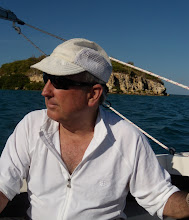
On Saturday evening friends and relatives from Beaufort, Atlanta, Savannah and Charleston attendeda Bon Voyage party in honor of JD and me held at the Beaufort Yacht and Sailing Club. This had been organized primarily by my sister and her family (Atlanta) and my good friend Frank Pontious in Beaufort. After everyone toured "Jubilee" the 30 to 40 of us enjoyed libations and a dinner of hors d'oeuvres, toasts, and friendship for a wonderful send-off.
Our departure, which had looked good for Sunday evening just 3 days ago has been postponed due to a forecast of gale force adverse winds and predictions of 15-foot waves related to a low pressure systems emerging out of the Bahamas that might become the season's first named tropical storm. This system would have crossed our path Monday-Tuesday just as we would be crossing the Gulf Stream. Packing winds in excess of 30 kts from the northeast, this system will likely be creating conditions that even large ships try to avoid.
It now looks like Thursday morning we will head down the Beaufort River and out to sea bound for Bermuda. The good news is that this gives us a few relaxed days to do some additional preparations and to be fully rested before leaving. The week leading up to departure on an offshore voyage is a lot like the week before opening night in a theatrical production. Inevitably there are a thousand things to be done. I will be away from home nearly 3 months. That alone is a big deal in terms of preparations. Then the boat. My rigger, Greg Pittrizzi, installed a new throttle control Friday and new fresh and sea water pumps yesterday(Saturday) morning. Other, less major, items still need attention.
Sunday, May 23, 2010


Saturday, May 22, 2010
Pictures from Sea Trial (aka Shake Down Cruise)
JD took these on our shakedown cruise.  The first is at sundown the first day, already well offshore. The pole on the starboard quarter goes up to the wind generator. The pole on the port quarter goes up to the radar. That package you see on the port stern contains our "LifeSling" man-over-board rescue device. You'll notice that I am wearing an inflatable life vest. It inflates with the pull of a string. It also serves as a harness. I have a six-foot and a three-foot tether that connects me to a "jackline" (nylon strap) that runs the length of the boat on both sides. Our rule is that we clip on anytime we are outside the cabin. The second picture is of our approach to Charleston the next day.
  The safety netting helps keep the downed foresails on board as well as our bodies. The third picture, obviously taken from within the cabin, shows that we did not fully properly repack the LifeSling after our M.O.B. drill, On the left is the door to the "head". A back-up hand-held GPS is in my lap. You'll notice a platform just outside the companionway (the case for my cell phone and a line is on it). This platform covers our life raft and ditch kit. It is important to have these items in a place that is easy to get to in an emergency. The life-raft is a four-person, a vacuum-packed raft that, with the pull of a line, will automatically unfold and inflate itself. It has a sheltering room. The ditch kit includes signal flares, a signaling mirror, a GPS, a VHF radio, a fishing kit, emergency rations, some fresh water, and a water-maker that converts sea water into fresh water. Just inside the companionway is our principal EPIRB signaling beacon device. In an emergency we can push a button on the EPIRB and it will automatically send an SOS signal to a satellite showing our precise location, identifying exactly who we are, and triggering a rescue mission by the Coast Guard or whatever rescue is close by. Signals will also get forwarded to all ships in the area. I hope we don't have to use any of the emergency stuff, but it is comforting to know that we are prepared.

 The first is at sundown the first day, already well offshore. The pole on the starboard quarter goes up to the wind generator. The pole on the port quarter goes up to the radar. That package you see on the port stern contains our "LifeSling" man-over-board rescue device. You'll notice that I am wearing an inflatable life vest. It inflates with the pull of a string. It also serves as a harness. I have a six-foot and a three-foot tether that connects me to a "jackline" (nylon strap) that runs the length of the boat on both sides. Our rule is that we clip on anytime we are outside the cabin. The second picture is of our approach to Charleston the next day.
  The safety netting helps keep the downed foresails on board as well as our bodies. The third picture, obviously taken from within the cabin, shows that we did not fully properly repack the LifeSling after our M.O.B. drill, On the left is the door to the "head". A back-up hand-held GPS is in my lap. You'll notice a platform just outside the companionway (the case for my cell phone and a line is on it). This platform covers our life raft and ditch kit. It is important to have these items in a place that is easy to get to in an emergency. The life-raft is a four-person, a vacuum-packed raft that, with the pull of a line, will automatically unfold and inflate itself. It has a sheltering room. The ditch kit includes signal flares, a signaling mirror, a GPS, a VHF radio, a fishing kit, emergency rations, some fresh water, and a water-maker that converts sea water into fresh water. Just inside the companionway is our principal EPIRB signaling beacon device. In an emergency we can push a button on the EPIRB and it will automatically send an SOS signal to a satellite showing our precise location, identifying exactly who we are, and triggering a rescue mission by the Coast Guard or whatever rescue is close by. Signals will also get forwarded to all ships in the area. I hope we don't have to use any of the emergency stuff, but it is comforting to know that we are prepared.
Wednesday, May 12, 2010
Report on Sea Trial
Our sea trial round trip from Beaufort to Charleston was 3 days, 2 nights at sea with 15 to 25 kt winds. Each direction took about 18 hours over-the-ground (by the GPS). We averaged 4.4 kts with a mix of favorable and unfavorable tidal currents, wind directions, and some use of the engine. True to the purpose of a sea trial, we found that some things did not work and we needed to change some things. This was JD's first night offshore in a sailboat. On the second night he described his sleep "like a stone". We returned happy, with a to-do list, and with enthusiasm for the fist leg of the big trip: to Bermuda, departing around May 24. Please see the full story at my website.
Woody
Woody
Tuesday, May 4, 2010
Sea Trial Begins on Friday - from Beaufort to Charleson & Back

Preparations are coming along toward a 3-day sea trial starting this Friday, May 7. The plan is JD, my sailing partner from Beaufort, SC to Bermuda and Bermuda to Nova Scotia will drive from Athens, GA to Beaufort on Thursday evening. We'll turn loose the dock lines around noon on Friday and sail up to Charleston, arriving Saturday in time for lunch and a walk around. Then we'll depart Charleston and spend Saturday night at sea, returning to Beaufort Sunday evening.
Right now, the weather looks fine although we could have a thunderstorm on Saturday. We'll deal with it just as we would at sea.
JD will be bringing all of his gear, though we might not take it all on the trial. The goal is to go through what his has and identify anything else that is needed. Synthetics are key to avoiding mildew and allow for quick drying.
The last items for the boat were installed yesterday. The main item was an extension of the keel to overlap the bottom of the rudder. This is intended to keep crab and lobster trap lines and fishing nets and other debris from getting tangled between the keel and the rudder.
Last night I made a plexiglass companionway cover that we'll use at sea in the rain. This will allow us to be able to read the instruments that are on the swinging panel in the companionway from the cockpit while keeping the rain out of the cabin.
The boat has been compounded and waxed and looks good. It is raining today, and the boat is suspended on the launching machine while the keel extension sets up. Tomorrow (Wednesday) we plan to step the mast and install the radar and wind generator and test the electrical system, then launch on the high tide in the afternoon. Thursday, my rigger (Greg Pittrizzi) and I will take her out to synchronize the systems, set the wind gauge compass, and ensure that the various systems are talking to each other in a coordinated way. We'll also test the charging systems.
Other things that are still on the list of "To Do's" today are I need to scrub out and sanitize the water tank and its pipes and then fill it. Also, on the inside, I need to check out the stove and install the holders for the propane portable heater. Additionally, I'll be installing a system of nylon straps to keep our gear and the sail inventory from sliding around while we are at sea. These are among today's tasks.
Tuesday, April 20, 2010
Sailing in December
JD Shiver and I needed to practice sailing together, offshore, to be sure that we would be compatible teammates on our passage in May and June to Bermuda and Nova Scotia. JD has had little offshore experience but is bright, has a natural talent for sailing, is blessed with good common sense, and can fix anything. I have sailed a lot, including some offshore, but I am a klutz at fixing things. Neither of us wanted to find out, half way to Bermuda, that we could not get along or that an offshore voyage was just something that we are actually not personally equipped to handle.
“Jubilee” was on her trailer at Marsh Harbor Boatyard for the winter. I have another sailboat however, that we could use for a short excursion offshore. “Myrdie II” is a Compac 16 sloop built in 1982. This is a very seaworthy craft for its size, weighing about 1,100 pounds and having a self-draining cockpit and a board covering the companionway to the small cabin to keep a breaking sea from swamping the interior.
We drove to Beaufort, SC, on a Friday afternoon, launched Myrdie II at Beaufort Yacht and Sailing Club (BYSC) and prepared her for sailing Saturday and Sunday. The weather predicted for Saturday was for temperatures in the 40s, rain, and north to northeasterly winds at 15 to 20 knots. For Sunday, the temperature would rise into the 50s and the winds would be a bit lighter, clocking to the east and southeast, but the seas would be large. Sunday’s ground swells, 5 to 7 feet offshore, and 8 to 10 feet closer in, would be generated in the Gulf Stream, some 60 miles offshore, on Saturday and Saturday night as the northeast wind would be blowing in the exact opposite direction from the flow of the Stream. This would be a perfect weekend to accomplish what we were setting out to do: Test ourselves in tough conditions.
You really never know what a person is like until you work with him (or her) under stress. Had this weekend been one of just a pleasant sail, we would not have come to know each other as we did in these stressful conditions.
Our objective was to sail from Beaufort north and east about 20 nautical miles (nm) on The Intracoastal Waterway (ICW) Saturday to Dataw Marina. On Sunday we would sail east from Dataw into the Atlantic, then turn south to Port Royal Sound, west into the Sound, and north on the Beaufort River back to BYSC. Sunday’s voyage would be about 40 nm as the crow flies. Tacking into the wind most of the day would add another 16 nm.
Saturday’s trip to Dataw was cold and wet. We learned the value of well-insulated gloves and competent foul weather gear. The little Compac sailboat had no trouble handling the 15-20 kt winds, and, although chilled nearly to the bone, this was a fine test of equipment and positive attitude.
Sunday would turn out to be quite a challenge. We left the Dataw dock at 7 AM, in the pre-dawn gray with a misty rain and wind directly on the nose. We used Myrdie’s 2 HP Honda outboard to motor out into the Atlantic. S we left the Morgan River into the Atlantic, we hoisted the sails and turned southeast across the bay on a route that in normal conditions would be fine. However, these were not normal conditions. We soon found ourselves in a field of breakers. Waves start to break when the height of the wave matches the depth of the water. We were in water with an 8 to 10 foot depth, plenty for the 3-foot 3-inch draft of a Compac 16. The 5 to 7-foot waves grew in the shallow water to 8 to 10 feet, and they were breaking all around us. We put the board into the companionway. We tacked over to Starboard and cranked up the motor to get to deeper water. Then, a wave broke over the cockpit, sweeping away everything that was loose including our detachable navigation lights and, more seriously, the lanyard that keeps open the kill switch on the motor. JD became seasick, reporting with humor that Vitamin Water tastes about the same coming up as it does going down. With the kill switch closed the motor would not start. We took another breaker over the boat, and to water in the cockpit was so high that it willed my sea boots. JD found me a small cord that I wrapped around the kill switch to keep it open, and the little Honda came back to life.
As we motor sailed to deeper water and the cockpit drained, I was suddenly struck with about 10 minutes of seasickness. This came from focusing on fixing the kill switch while the boat was being tossed around. Have you ever tried to read a book as a passenger in car on a bouncy dirt road? It was sort of like that, times ten.
When we got out about 4 miles from shore the lumps of sea settled down and we tacked back to port. The sea was mixed. The wind had clocked to the east-southeast, but the big waves were coming from the northeast. I’ll have to say that there is a wondrous feeling surfing down the face of a following sea while beating to windward. My mal-de-mer had passed quickly and, although my feet were getting cold, I was again enjoying our voyage. JD remained under the weather, and his head was spinning like he reported the compass to be doing (do not try to use a cheap compass offshore).
We beat to windward throughout the afternoon. The wind continued to clock to the right, ultimately coming from the southwest. We had several worries. First, we were expected to arrive at BYSC by around 5 PM and we knew our friends attending a party at the club would be worrying about us. Second, sundown would be around 5:30 PM, and we had lost our navigation lights overboard. Third, high tide was expected around 6 PM in Port Royal Sound, and, after that, we would be facing an adverse current for the approximately 10 nm up the Beaufort River to our destination at BYSC. A further complication could develop if we took the planned Baypoint Reach shortcut into Port Royal Sound. The concern was that the waves could be breaking, as earlier in the day, when we got close to shore. The alternative was to sail several miles farther out to a place where we could cross into the channel leading to the Sound. That would take too much time. With that alternative we would surely be at sea after dark and facing an adverse tide. We decided to go for the Baypoint Reach.
The Reach is a narrow (about 100 feet wide) channel running east-west just off the southern point of Phillips Island. I had never been there before but had noted it on both the electronic and paper charts. We approached the Reach with caution, looking for possible breakers that would cause us to abandon the route. Sailing a west-northwest course, we could see huge breakers ahead. We kept sailing, closer and closer to the breakers in front of us, knowing we could tack out if we needed to abandon. Suddenly, we could see the Reach, like a alley of calm between the reef and the land. The moment felt like Moses must have felt as the Red Sea parted to enable the Exodus from Egypt. On the port side, waves were crashing on a reef. On starboard, waves broke on shore. We cruised through the channel with the help of the little Honda just after 5:30, as the light dimmed to twilight.
As we cleared the Reach and heaved a sigh of relief, JD called Frank Pontious’ home, hoping he would get the message that we were safe and would arrive at BYSC around 7:30. My cell phone’s battery was dead, so we did not have his mobile number. Meanwhile, at the BYSC party, our friends were indeed starting to worry about us. They decided around 6 PM to organize a search. Frank went home to retrieve his GPS while others started to launch his boat. He just happened to check his phone messages as he got his GPS. This was very fortunate, and so the search was called off and our friends relaxed and waited for our arrival.
As we came into the dock at BYSC, JD was apologetic about being too sick to be at the helm. I assured him that it was no problem for me to be at the helm for 12 ½ hours, and in fact it was a good test of endurance for the both of us. JD seemed unsure if he had passed the test. He said he had read that seasickness lasts only 2 or 3 days at the most and that he was sure he would be OK in our voyage to Bermuda, which would last about 8 days. I really liked his positive attitude. He will be a fine teammate all the way to Nova Scotia.
3/6/2010
Wednesday, November 18, 2009
Hazards and Safety
Most people have no idea of what it takes to prepare a boat for sailing off shore. Preparation is serious business since you are taking your life and the lives of anyone on board into hazardous conditions that can be life-threatening. The hazards are numerous and include stormy weather, collisions with other vessels, falling overboard (the three biggest hazards) and becoming ill, having engine and rigging failures, losing electrical power, and spoiling your supplies of food and water.
The good news is that an off-shore boat is made to float like a cork in the most menacing conditions, and modern technology makes off-shore sailing much, much easier and safer than even ten years ago.
My Flicka, like any competent off-shore sailboat, has a keel of sufficient weight (1,800 pounds) so that even if rolled upside down she will right herself much like those inflatable clowns with the sand in the bottom. The companionway leading from the cockpit to the cabin can be boarded up in rough weather so that the cabin is essentially water-tight. The boat could be completely submerged in a wave and the boards would keep all but a trickle of the water out. When the wave passes, the boat rights herself, and water in the cockpit will quickly drain out the scuppers.
The Flicka is way overbuilt for a boat her size. Who would guess that her 20-foot length would weight 6,000 pounds before loading her with people and supplies? The rigging is the same is would be typical for a sailboat in the 40 to 50-foot range. The 30-foot mast, with its rigging, weighs nearly 175 pounds and is held up by nine (yep, 9) stays: 2 back stays, 6 side stays, and 1 forestay.
Safety at sea in Jubilee is my #1 priority. Following are just some of the steps I am taking to mitigate the risks:
The good news is that an off-shore boat is made to float like a cork in the most menacing conditions, and modern technology makes off-shore sailing much, much easier and safer than even ten years ago.
My Flicka, like any competent off-shore sailboat, has a keel of sufficient weight (1,800 pounds) so that even if rolled upside down she will right herself much like those inflatable clowns with the sand in the bottom. The companionway leading from the cockpit to the cabin can be boarded up in rough weather so that the cabin is essentially water-tight. The boat could be completely submerged in a wave and the boards would keep all but a trickle of the water out. When the wave passes, the boat rights herself, and water in the cockpit will quickly drain out the scuppers.
The Flicka is way overbuilt for a boat her size. Who would guess that her 20-foot length would weight 6,000 pounds before loading her with people and supplies? The rigging is the same is would be typical for a sailboat in the 40 to 50-foot range. The 30-foot mast, with its rigging, weighs nearly 175 pounds and is held up by nine (yep, 9) stays: 2 back stays, 6 side stays, and 1 forestay.
Safety at sea in Jubilee is my #1 priority. Following are just some of the steps I am taking to mitigate the risks:
- Storm preparation: I plan to engage a land-based weather and course advisor. These folks will track our progress and through a daily communication, will advise of weather developments forecast for our area and make suggesations when appropriate for altering course to avoid the worst of the developing storms. second, I plan to shorten sail early in anticipation of rough weather. The Flicka has two reefs on the mainsail and one on the jib. If it looks like it will be too rough for the reefed main and jib, we can put up the storm trisail (small main) and storm jib. In the worst conditions we can heave to and deploy a sea anchor (looks like a parachute that drags in the sea) and clip on a stern line to balance the boat at about a 40 degree angle to the wind and waves. This has an amazingly calming effect on the incoming seas and is a tried and true way of riding out a storm. If the storm is blowing from a direction that helps us on our course, we'll deploy a drogue instead of the sea anchor (my drogue is like a small sea anchor) and sail downwind. The purpose of the drogue, which is deployed astern, is to slow the boat, keep the sterrn pointed into the oncomeing waves, and prevent the boat from running down a wave so fast that it puitch-poles (summer-saults) end over end.
- Falling off the boat: We will always be "clipped on" when outside the cabin. What this means is that our inflatable life jackets, which are worn at all times outside the cabin, have built-in harnesses, and the harness will be attached to "jack-lines" (nylon webbing) that runs the length of the boat from the boat to the stern. A six-foot tether connects the harness to the jack lines. If one of us goes overboard, the tethered harness should keep us with the boat until we can climb back on board. We will also practice Man Overboard (MOB) rescue procedures.
- Collisions at Sea: Collisions are rare but can be a disaster if it happens. We will be sailing in some busy shipping lanes, at night and in fog. We are taking many precautions. First (aside from being on watch and scanning the horizon continually) we have radar. Mine is a Furuno 1623, mounted on the port back stay, facing aft on a Waltz gimbol. This radar can see about 16 miles and will be on at night and in foggy conditions. It can be set to sleep most of the time to minimize poer consumption but to awake for a scan every 5 or 10, or 15 minutes. It will emit an audible sound if it sees something on a scan. Second, we will have an Automatic Identification System (AIS) transponder that will be programmed to constantly send out our identity, including our speed and bearing to any other vessel in the area. It also will receive and plot on our GPS screen the identity of any other vessel in the area and show their speed and bearing. If there is a possibility of a collision it emits an audible and shows on the screen where it might happen. This is a new thing in recent years, but all commercial vessels are required to have this equipment functioning. It is a huge improvement in safety. Third, I have installed a tri-color light at the top of the mast whch is much more visible to ships than the standard navigations lights on the hull. We will also hoist up a radar reflector that will definitely make us visible to anyone with radar. Finally, we have a ship's bell and a fog horn to use in the fog.
- Illness: Sea sickness can be expected in rough weather, and I will have tablets (and a bucket) for that. Colds and the flu are rare since there is no one around to give you the bug. The most serious kind of illness would be a severe injury or heart attack. In a seriously life-threatening situation we will call for help wherever we are. For less serious injury we will have standard first aid and splints to stabilize broken bones. We will never expect to be more than 5 days from shore.
Thursday, October 15, 2009
The Plan, the Boat, and the Background
Summary of the Passage
In the last week of May, 2010, I plan to depart from Beaufort, SC on my Flicka 20 sailboat, "Jubilee" for a passage that is expected to last about two months. The first stop will be Bermuda, about 820 nautical miles (nm) to the east. A friend, JD Shriber, plans to sail with me to Bermuda and then on to Nova Scotia as well. The leg to Bermuda is expected to take about 8 days. After a rest and re-provisioning, we will depart Bermuda bound for Nova Scotia, Canada, which is about 780 nm due north, another 8 days. After a short visit with my friends Kiersten and Bill Gilkerson near Mahone Bay, I plan to sail to Portland, then Newport, then Oyster Bay, NY. A fellow Flicka sailor plans to join me in Newport for the leg to Oyster Bay. Another fellow Flicka sailor will join me at Oyster Bay for the very exciting trip past New York City, down the East River and out the Narrows, to Sandy hook, NJ. Departing Sandy Hook, the plan is to sail south to Delaware Bay, up the bay to the Delaware-Chesapeake Canal, past Baltimore, to Annapolis. My patient and trusting wife, Alice Lynch, will join me at Annapolis for the sail down the Chesapeake Bay to the historic towns of St. Michaels and Oxford on the Maryland eastern shore. Then, with short stops at Hardyville, VA and Norfolk, I plan to return to Beaufort in the Atlantic (except to use the Intracoastal Waterway in bad weather). The final legs will include brief stops in the Outer Banks, Wrightsville Beach, Southport, Georgetown and Charleston, with various friends joining me along the way. I hope to arrive back in Beaufort by early August, before the serious part of the hurricane season.
A Flicka 20, and "Jubilee"
A Flicka 20 is a sailboat that, despite its relatively diminutive 20 foot length (on the deck), is built to take you anywhere in the world. These boats weigh about 6,000 pounds (empty) and have a cult following for their beauty and functional capacities. Numbering 434 ever produced, most of them were built by Pacific Seacraft between 1975 and 1996. "Jubilee" was built in 1993 and was hull number 418. She has a Yanmar diesel engine (one cylinder, using about a quart of fuel per hour), an enclosed head, a galley with alcohol stove, sink, and icebox, V-berths forward, and a quarter-berth aft. "Jubilee" is sloop-rigged, but I have also added a staysail to make her a cutter, and she carries a cruising spinnaker ("Gennaker") while reaching and running down wind. You can learn more about Flickas at www.Flicks20.com.
I bought Jubilee from Frank Durant in February 2008. Frank had just returned from a 6-week trip to the Bahamas where he bought some property and wanted to sell the boat to build a house. The original owner was a lady who lived in Iowa where she sailed Jubilee on a lake during the summers. The boat had never seen salt water until frank dipped her in the Atlantic in 2007.
Pacific Seacraft stopped making the Flickas in 1996 when the costs of production simply outstripped the price people were willing to pay. I have read that a new, equipped Flicka in 1996 would cost the buyer nearly $100,000, although I would think about $70,000 was more like it. Still, that would be a lot for a 20-foot sailboat in 1996.
In a later blog I will describe what it takes to get a boat ready for an ocean passage. I have invested over $30,000 (after buying the boat) and she is not yet quite ready.
Background
I have dreamed of making a passage like this since I was a kid. I am now 68 and plan to do this at age 69.
In the 4th grade I was drawing technically correct sailing ships although I had never been on a sailboat. Atlanta, GA was not a port city. I was just fascinated by the idea that boats could be pushed through the water by the wind. Lake Allatoona, near Atlanta, was created in 1949 by damming up the Etawah River, and my parents bought a Snipe Class sailboat and joined the Atlanta Yacht Club when it was formed in 1950. I crewed a few times but wanted to be the skipper as I understood quickly to the dynamics of sailing. After demonstrating competence at the helm of my father's Snipe, he passed it along to me in 1953 and bought himself a new one. Throughout the 1950s I raced competitively in regattas around the USA. I servesd as the Racing Team Captain (and Commodore) of the Tulane University Sailing club in the early 1960s. After graduate school at The University of Chicago I moved to new york City and sailed the summer Long Island Sound Circuit on a 35 foot yawl, "Escape", owned by Harlow Reed. This was heaven to me, although in retrospect, it was unfair to be leaving my wife and kids in the city for the sumer week-ends. After 2 years in NYC we moved to Florida and then back to Atlanta, and I was too busy developing my career and raising my family to be sailing off shore. I did resume sailing Snipes, 15 1/2-foot dinghies, both in the USA and abroad.
Gradually, I lost interest in sailing dinghies around the buoys. Lake Allatoona is not big enough for larger boats, and the sailing conditions, even in dinghies, are, well, not ideal. On a visit to Nova Scotia in 2003 to visit our friends, the Gilkersons, I was introduced to a Herreshoff 12 1/2 owned by Kerstin. After five minutes at the helm I knew I had to have one.
I had "Myrdie" built at Cape Cod Shipbuilding (www.CapeCodShipbuilding.com) and took delivery in May 2004. This boat was perfect for doing adventures in the Intracoastal Waterway (ICW). I took he over to Beaufort (about half way between Savannah and Charleston) and sailed further and further distances until I started visualizing making an ICW "passage" from Savannah to Charleston. In April 2005, with the help of my wife and some friends, I made this passage, with overnight stops at Hilton head Island, Beaufort, Edisto island and Seabrook Island. It was a wonderful adventure. As other people heard about it they all seemed to think it was a neat idea, so the following year we did it again with about 10 other boats. This event turned into "The Classic Boat Rally", for boats of classic design in a size range 15 to 24 feet. See www.ClassicBoatRally.com.
By 2007 I was starting to modify "Myrdie" to be able to take her off shore, installing a battery-operated bilge pump among other things. Then it dawned on me....what was I thinking??? Taking a 15-foot open boat off shore was a dumb idea. About that time I tripped across the Flicka 20 web site, and just seeing pictures of these boats took me back to the days of my mid-life crisis in the late 1970s when I was reading books about sailing around the world and researching boats in which to do it. I remember thinking then, 30 years earlier, that the Flicka was one small boat that could do it. Excitedly scanning the list of Flickas for sale, I stopped when I saw "Jubilee". Uniquely, this boat was in near perfect condition, almost as new, with little time on the engine, a scant 6 weeks in salt water, and located in Florida, a one-day drive away. I paid frank his asking price when I picked her up in February 2008. Then I sold my Herreshoff 12 1/2 "Myrdie", getting almost what I had paid 4 years earlier.
It takes at least a year to prepare for an off-shore passage. I started serious planning for my 2010 passage in the spring of 2009. "Jubilee" will get me where I need to go.
Blog Site Plans
I am starting this blog at the urging of my friends for several reasons. First, I plan to document the process that I am going through to plan and prepare for this passage in the hope that other who are contemplating a similar undertaking might benefit from my experience. Second, I hope that those with experience relative to my planning and preparation efforts will respond with a reply that will be of benefit to me and to others with similar plans. Third, I plan to use this site for reporting progress and developments as I make the passage. I will share the joys and the challenges experienced along the way.
Pictures are worth a thousand words, and I plan to post pictures and a chart of my route when I learn how to do this.
In the last week of May, 2010, I plan to depart from Beaufort, SC on my Flicka 20 sailboat, "Jubilee" for a passage that is expected to last about two months. The first stop will be Bermuda, about 820 nautical miles (nm) to the east. A friend, JD Shriber, plans to sail with me to Bermuda and then on to Nova Scotia as well. The leg to Bermuda is expected to take about 8 days. After a rest and re-provisioning, we will depart Bermuda bound for Nova Scotia, Canada, which is about 780 nm due north, another 8 days. After a short visit with my friends Kiersten and Bill Gilkerson near Mahone Bay, I plan to sail to Portland, then Newport, then Oyster Bay, NY. A fellow Flicka sailor plans to join me in Newport for the leg to Oyster Bay. Another fellow Flicka sailor will join me at Oyster Bay for the very exciting trip past New York City, down the East River and out the Narrows, to Sandy hook, NJ. Departing Sandy Hook, the plan is to sail south to Delaware Bay, up the bay to the Delaware-Chesapeake Canal, past Baltimore, to Annapolis. My patient and trusting wife, Alice Lynch, will join me at Annapolis for the sail down the Chesapeake Bay to the historic towns of St. Michaels and Oxford on the Maryland eastern shore. Then, with short stops at Hardyville, VA and Norfolk, I plan to return to Beaufort in the Atlantic (except to use the Intracoastal Waterway in bad weather). The final legs will include brief stops in the Outer Banks, Wrightsville Beach, Southport, Georgetown and Charleston, with various friends joining me along the way. I hope to arrive back in Beaufort by early August, before the serious part of the hurricane season.
A Flicka 20, and "Jubilee"
A Flicka 20 is a sailboat that, despite its relatively diminutive 20 foot length (on the deck), is built to take you anywhere in the world. These boats weigh about 6,000 pounds (empty) and have a cult following for their beauty and functional capacities. Numbering 434 ever produced, most of them were built by Pacific Seacraft between 1975 and 1996. "Jubilee" was built in 1993 and was hull number 418. She has a Yanmar diesel engine (one cylinder, using about a quart of fuel per hour), an enclosed head, a galley with alcohol stove, sink, and icebox, V-berths forward, and a quarter-berth aft. "Jubilee" is sloop-rigged, but I have also added a staysail to make her a cutter, and she carries a cruising spinnaker ("Gennaker") while reaching and running down wind. You can learn more about Flickas at www.Flicks20.com.
I bought Jubilee from Frank Durant in February 2008. Frank had just returned from a 6-week trip to the Bahamas where he bought some property and wanted to sell the boat to build a house. The original owner was a lady who lived in Iowa where she sailed Jubilee on a lake during the summers. The boat had never seen salt water until frank dipped her in the Atlantic in 2007.
Pacific Seacraft stopped making the Flickas in 1996 when the costs of production simply outstripped the price people were willing to pay. I have read that a new, equipped Flicka in 1996 would cost the buyer nearly $100,000, although I would think about $70,000 was more like it. Still, that would be a lot for a 20-foot sailboat in 1996.
In a later blog I will describe what it takes to get a boat ready for an ocean passage. I have invested over $30,000 (after buying the boat) and she is not yet quite ready.
Background
I have dreamed of making a passage like this since I was a kid. I am now 68 and plan to do this at age 69.
In the 4th grade I was drawing technically correct sailing ships although I had never been on a sailboat. Atlanta, GA was not a port city. I was just fascinated by the idea that boats could be pushed through the water by the wind. Lake Allatoona, near Atlanta, was created in 1949 by damming up the Etawah River, and my parents bought a Snipe Class sailboat and joined the Atlanta Yacht Club when it was formed in 1950. I crewed a few times but wanted to be the skipper as I understood quickly to the dynamics of sailing. After demonstrating competence at the helm of my father's Snipe, he passed it along to me in 1953 and bought himself a new one. Throughout the 1950s I raced competitively in regattas around the USA. I servesd as the Racing Team Captain (and Commodore) of the Tulane University Sailing club in the early 1960s. After graduate school at The University of Chicago I moved to new york City and sailed the summer Long Island Sound Circuit on a 35 foot yawl, "Escape", owned by Harlow Reed. This was heaven to me, although in retrospect, it was unfair to be leaving my wife and kids in the city for the sumer week-ends. After 2 years in NYC we moved to Florida and then back to Atlanta, and I was too busy developing my career and raising my family to be sailing off shore. I did resume sailing Snipes, 15 1/2-foot dinghies, both in the USA and abroad.
Gradually, I lost interest in sailing dinghies around the buoys. Lake Allatoona is not big enough for larger boats, and the sailing conditions, even in dinghies, are, well, not ideal. On a visit to Nova Scotia in 2003 to visit our friends, the Gilkersons, I was introduced to a Herreshoff 12 1/2 owned by Kerstin. After five minutes at the helm I knew I had to have one.
I had "Myrdie" built at Cape Cod Shipbuilding (www.CapeCodShipbuilding.com) and took delivery in May 2004. This boat was perfect for doing adventures in the Intracoastal Waterway (ICW). I took he over to Beaufort (about half way between Savannah and Charleston) and sailed further and further distances until I started visualizing making an ICW "passage" from Savannah to Charleston. In April 2005, with the help of my wife and some friends, I made this passage, with overnight stops at Hilton head Island, Beaufort, Edisto island and Seabrook Island. It was a wonderful adventure. As other people heard about it they all seemed to think it was a neat idea, so the following year we did it again with about 10 other boats. This event turned into "The Classic Boat Rally", for boats of classic design in a size range 15 to 24 feet. See www.ClassicBoatRally.com.
By 2007 I was starting to modify "Myrdie" to be able to take her off shore, installing a battery-operated bilge pump among other things. Then it dawned on me....what was I thinking??? Taking a 15-foot open boat off shore was a dumb idea. About that time I tripped across the Flicka 20 web site, and just seeing pictures of these boats took me back to the days of my mid-life crisis in the late 1970s when I was reading books about sailing around the world and researching boats in which to do it. I remember thinking then, 30 years earlier, that the Flicka was one small boat that could do it. Excitedly scanning the list of Flickas for sale, I stopped when I saw "Jubilee". Uniquely, this boat was in near perfect condition, almost as new, with little time on the engine, a scant 6 weeks in salt water, and located in Florida, a one-day drive away. I paid frank his asking price when I picked her up in February 2008. Then I sold my Herreshoff 12 1/2 "Myrdie", getting almost what I had paid 4 years earlier.
It takes at least a year to prepare for an off-shore passage. I started serious planning for my 2010 passage in the spring of 2009. "Jubilee" will get me where I need to go.
Blog Site Plans
I am starting this blog at the urging of my friends for several reasons. First, I plan to document the process that I am going through to plan and prepare for this passage in the hope that other who are contemplating a similar undertaking might benefit from my experience. Second, I hope that those with experience relative to my planning and preparation efforts will respond with a reply that will be of benefit to me and to others with similar plans. Third, I plan to use this site for reporting progress and developments as I make the passage. I will share the joys and the challenges experienced along the way.
Pictures are worth a thousand words, and I plan to post pictures and a chart of my route when I learn how to do this.
Subscribe to:
Posts (Atom)